
I'm back: AI Engineering Summit 2025: Bash-Pilled and Building for Everyone
The last post I wrote was being staggered by GPT-5 back in September, basically an eon ago in AI time and now we're all staggered by how smart Opus 4.5 is. Back in the long time ago -- last week -- I was at the AI Engineering Summit and we are all marveling on the insane capabilities of Gemini 3.
The AI Engineering Summit in November 2025 brought together a great crowd of people who are right at the forefront of all of the AI activity. I've been busting through all of my usage limits on all the models pretty much every day since then trying out all these new ideas.
I did a full write up of everything with 12 articles covering all sorts of topics, check it out: Read the full report.
But lets get into it now:
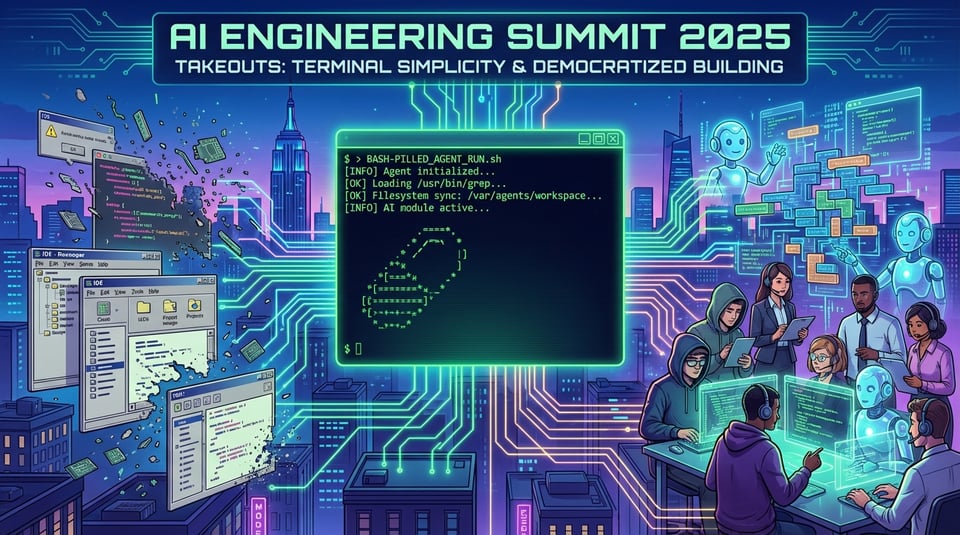
Steve Yegge declared "if you're still using an IDE by January 1st, you're a bad engineer." It s good quote, and with Opus 4.5 and Gemini 3 I'm very very close to writing pure feature specs and "treating code like assembly" -- stuff I could look at I guess but why bother. The models are smart -- look at this "fully featured" 25 line coding agent I wrote. Your first ask of it: make yourself smarter. The Claude Code team calls this getting "bash-pilled," and they're not alone. Read more on model minimalism →

Another huge shift is "who builds". Support engineers resolving tickets are moving onto dev teams. Non-developers created 1,000+ production skills in 5 weeks at Anthropic. And -- "2 engineers create the tech debt of 50." We're the last generation writing code by hand—the bottleneck is now task assignment and code review, not capability. Read more on role transformation →
Yes, but no: Stanford tracked 120,000 developers: clean codebases get 35-40% productivity gains, legacy messes get 0-10%. So much of the additional productivity could be just cleaning up yesterdays mess. Quality is the differentiator when generation becomes cheap. "Do not outsource the thinking"—AI only amplifies what you've already done. Read more on code quality →
Read the full report → — 12 deep-dive articles covering economics, context engineering, agent architecture, and the future of the SDLC.


